
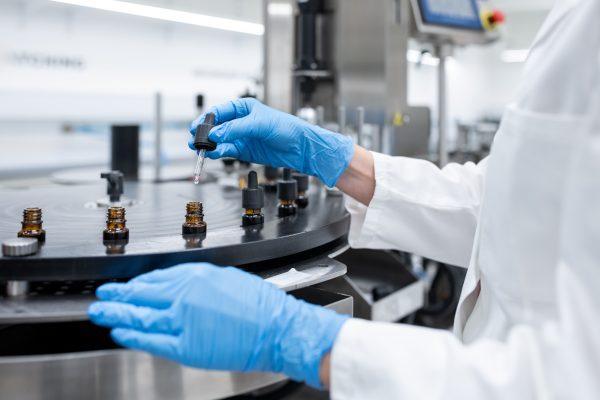
In the EU, a CBD tincture may be filled only by a facility authorised for the product’s legal category. A medicinal tincture requires a filler holding a Manufacturing and Import Authorisation (MIA) with an EU-GMP certificate listed in EudraGMDP, and the batch must be released by a Qualified Person. A food-supplement tincture requires a registered food business operating HACCP and, in practice, ISO 22000 or an equivalent supplement GMP scheme. A cosmetic oil requires ISO 22716 compliance and a designated Responsible Person. Some facilities hold certification across more than one route, PharmaHemp in Slovenia, for example, is certified for the cosmetic and food-supplement routes, but no facility’s certification automatically extends to all three.
In this guide:
- Short answer: three different fillers, three different rules
- What “GMP” actually means for a CBD tincture
- Who can fill a medicinal CBD tincture
- Who can fill a CBD food supplement tincture
- Who can fill a CBD cosmetic oil or serum
- Who cannot fill your tincture, and why it matters
- How to verify a filler’s GMP status in 10 minutes
- What GMP tincture filling actually involves
- EU contract fillers for CBD tinctures
- THC limits by country
- MOQ, lead times and cost
- Tolling vs. contract filling vs. white label for tinctures
- Documentation you should receive with every batch
- FAQ
- Sources

Short answer: three different fillers, three different rules
| Legal category | Governing framework | What the filler must hold | Who releases the batch |
| Medicinal product | Directive 2001/83/EC, EudraLex Volume 4 (incl. Annex 7) | Manufacturing and Import Authorisation (MIA), EU-GMP certificate listed with a national competent authority (NCA), registration in EudraGMDP | Qualified Person (QP), Article 48 |
| Food supplement | Regulation (EU) 2015/2283 (Novel Food), Regulation (EC) 178/2002, general hygiene rules | Registered food business, HACCP, ISO 22000 or equivalent supplement GMP | Quality manager + Certificate of Analysis |
| Cosmetic | Regulation (EC) No 1223/2009 | ISO 22716 (cosmetics GMP), Product Information File (PIF), CPNP notification | Responsible Person |
A single manufacturer can be certified for more than one of these paths, but no single certificate automatically covers all three. A cosmetics-certified facility (ISO 22716) is not authorised to fill a product marketed as a medicine, and an EU-GMP certificate for an active pharmaceutical ingredient (Part I) does not automatically extend to filling a finished dosage form (Part II). Confirm which specific authorisation applies to your product’s actual legal category before assuming any GMP claim covers it.
What “GMP” actually means for a CBD tincture
“GMP certified” gets used as a blanket claim across all three categories, but the underlying standard, and what it authorises, is different in each case.
EU-GMP for medicinal products (EudraLex Volume 4)
EudraLex Volume 4 is the EU’s GMP framework for medicinal products, implementing Directive 2003/94/EC. It’s structured in parts: Part I covers finished medicinal products, Part II covers active pharmaceutical ingredients (APIs). A facility certified under Part II for a CBD API is not automatically authorised under Part I to fill a finished tincture, these are distinct authorisations.
Annex 7 and herbal preparations
Annex 7 of EudraLex Volume 4 addresses manufacture of herbal medicinal products specifically, relevant where a CBD tincture is positioned as a herbal medicinal product rather than a conventional pharmaceutical.
ISO 22716, cosmetic GMP
ISO 22716 is the recognised GMP standard for cosmetics, referenced by Regulation (EC) 1223/2009. It has no jurisdiction over products marketed as medicines or food supplements.
GMP for food supplements: what it is and isn’t
Unlike medicinal products, food supplements have no single unified EU GMP standard. Requirements are implemented at member-state level, generally built around HACCP and ISO 22000 food safety management. A “GMP certified supplements” claim should be read in that context, not as equivalent to EudraLex Volume 4.
For the fuller regulatory picture, see our overview of food supplement legislation in the EU.
Who can fill a medicinal CBD tincture
A facility filling a CBD tincture marketed as a medicine needs a Manufacturing and Import Authorisation (MIA), issued by a national competent authority, and an EU-GMP certificate covering the specific product type and dosage form, listed in EudraGMDP, the EU’s public database of manufacturing authorisations and GMP certificates.
Every batch must be certified for release by a Qualified Person (QP), a role defined under Article 48 of Directive 2001/83/EC. The QP takes personal, legal responsibility for confirming that each batch was manufactured and tested in accordance with EU GMP and the product’s marketing authorisation before it can be released to market. This is not a formality, a QP who signs off a batch is putting their own professional accountability behind that decision, which is part of why medicinal-route manufacturing carries the compliance weight it does.
This is the strictest and most heavily regulated of the three routes covered in this guide, and in practice the smallest population of CBD tinctures falls under it, most CBD products on the EU market are positioned as cosmetics or food supplements rather than authorised medicines, since obtaining a full marketing authorisation for a medicinal product is a substantially longer and more expensive process than the supplement or cosmetic routes.
If your product genuinely needs to go through this route, for example because you intend to make therapeutic claims that only a licensed medicine is permitted to make, budget for a materially longer timeline and a narrower pool of eligible manufacturing partners than either of the other two paths. A facility’s general “GMP certified” claim is not sufficient here, confirm the specific MIA, its scope, and its EudraGMDP listing before proceeding, using the verification steps outlined later in this guide.
Who can fill a CBD food supplement tincture
A facility filling a CBD tincture sold as a food supplement needs to be a registered food business operating under HACCP principles, generally supported by ISO 22000 or an equivalent food safety management certification. This is the route the large majority of commercially available CBD tinctures in the EU actually take, it’s less procedurally heavy than the medicinal path while still requiring a properly certified, GMP-run facility behind the finished product.
Because most CBD extracts fall under Novel Food requirements (Regulation (EU) 2015/2283), the specific ingredient used in the tincture needs a valid Novel Food status, or an application in progress, before it can legally be sold as a supplement in the EU. This is a common point of confusion, a facility can hold perfectly valid HACCP and ISO 22000 certification and still be unable to legally sell your finished product if the underlying cannabinoid ingredient’s Novel Food status isn’t resolved, the two are separate questions and both need to be answered.
A Certificate of Analysis per batch, confirming cannabinoid content and screening for heavy metals, pesticides, residual solvents, and microbiological contamination, is standard practice at this level, even though release isn’t as formally codified as QP sign-off under the medicinal route. In practice, this means the quality manager or equivalent role at the filling facility reviews test results and batch records before finished units are released to the brand.
For a deeper walkthrough of the Novel Food process itself, see our guide on understanding Novel Food status.
Who can fill a CBD cosmetic oil or serum
A facility filling a CBD product marketed as a cosmetic (a skin oil or serum rather than an ingestible tincture) needs ISO 22716 certification and must work with a designated Responsible Person, who compiles the Product Information File (PIF) and handles notification through the Cosmetic Products Notification Portal (CPNP) before the product goes to market. This can be the manufacturer, the brand, or a third party, but it must be explicitly assigned, it doesn’t default automatically to whoever physically produced the item.
See our certifications page for the specific standards a cosmetics-route filler should hold.
For more on CBD specifically in cosmetic formulations, see our guide on the use of CBD in cosmetics.
Who cannot fill your tincture, and why it matters
This distinction gets glossed over more than any other in this space. A facility holding EU-GMP certification for a CBD API (Part II) is not automatically authorised to fill a finished dosage form (Part I), these are separate authorisations covering different stages of production. Similarly, a facility certified only under ISO 22716 for cosmetics has no authorisation to fill a product marketed as a medicine or, in most cases, a food supplement, cosmetics GMP and food/medicinal GMP are entirely separate regulatory tracks with different requirements. Before committing to a filler, confirm the specific authorisation matches your product’s actual legal category, not just that the facility holds “GMP certification” in some general sense.
How to verify a filler’s GMP status in 10 minutes
Checking a manufacturer’s certification claims doesn’t require legal expertise, it requires knowing where to look and what specific details to ask for.
- Ask for the certificate, not the logo. A logo on a website proves nothing on its own, and logos don’t expire when certifications do.
- Check the scope. The certificate should specify the exact dosage form, product type, and physical site it covers, not just the company name. A certificate covering one facility under a parent company doesn’t automatically extend to a different site.
- Check the issuing authority. An EU-GMP certificate should be issued by a recognised national competent authority (NCA). ISO certifications should name an accredited or recognised certification body.
- Search EudraGMDP directly. For medicinal-route fillers specifically, the EU’s public EudraGMDP database lets you search by manufacturer name or country to confirm a listed manufacturing authorisation and its current status, this is publicly accessible and takes only a few minutes.
- Confirm the certificate number, address, and expiry date match what you’ve been told directly, not just a general assurance that the company is “GMP certified.”
- For ISO 22716 or ISO 22000 specifically, ask which certification body issued it and whether it’s accredited or non-accredited, both types exist legitimately in this space, but it’s worth knowing which one you’re looking at.
If a manufacturer is reluctant to provide certificate numbers or allow this kind of verification, treat that reluctance itself as useful information. Reputable, properly certified fillers are generally comfortable with this level of scrutiny, since it’s exactly the process a diligent customer should go through before shipping material worth tens of thousands of euros to a facility they’ve never worked with. If you’d like help interpreting a certificate you’ve received from a prospective filler, reach out to our team.
What GMP tincture filling actually involves
Beyond certification and paperwork, it’s worth understanding what the physical filling process itself looks like, since this affects what you should be asking a prospective filler.
| Element | Typical range |
| Bottle sizes | 10 ml, 30 ml, 50 ml, 100 ml dropper bottles |
| Glass type | Violet or amber glass for light protection |
| Fill accuracy | Depends on bottle or jar size, smaller formats generally hold tighter tolerances than larger ones, confirm the specific range for your chosen size with your filler |
| Headspace control | Managed to limit oxidation |
| Nitrogen flushing | Used by some fillers to reduce oxidation during filling |
| Closures | Standard dropper caps or child-resistant closures, depending on target market |
| Tamper evidence | Induction seal or shrink band |
| Batch coding | Lot number and expiry date applied at filling |
Violet and amber glass are preferred over clear glass or standard PET because CBD oil degrades under light exposure over time. Both glass types block a meaningful portion of the light spectrum responsible for that oxidation. Fill accuracy also matters more than it might seem, since a tincture’s dosing claim on the label depends on consistent fill volume from batch to batch.
Nitrogen flushing, displacing oxygen in the bottle’s headspace with inert nitrogen gas before sealing, is a detail some fillers apply and others don’t. It’s not universally required, but it can meaningfully extend a tincture’s stable shelf life, worth asking about specifically if your product needs a longer dated shelf life for a particular market.
Our filling line handles dropper bottles from 10 to 100 ml at up to 10,000 units per day, with fill volumes starting from 1 ml. The actual bottleneck in production isn’t the filling step itself, it’s downstream: capping is largely manual work (roughly a couple of people working a full day to close 1,000 units), and cartoning, if required, adds further time beyond that. Standard lead time runs 2-3 weeks from confirmed order to dispatch. For urgent orders with standard packaging and no unusual requirements, rush turnaround can be as fast as 2 days.
EU contract fillers for CBD tinctures
The market includes a range of European contract fillers operating under different combinations of the three regulatory paths above. Rather than only describing our own capabilities, here’s a general, neutral overview of the landscape, always confirm current certification status directly with any manufacturer before committing, certifications and scopes change over time and shouldn’t be assumed from a website claim alone.
| Manufacturer | Country | Certifications | Fills finished tinctures? | Accepts customer-supplied bulk (tolling)? |
| PharmaHemp | Slovenia | ISO 22716, ISO 9001, ISO 22000, HACCP | Yes (oils, tinctures, topicals, creams, skincare) | Yes |
| Candropharm | Netherlands | ISO 9001:2015, ISO 13485:2016, ISO 22716:2007 | Publicly lists oils, tinctures, gummies, vapes, and creams, contact them directly to confirm specifics | Not publicly confirmed |
| Essentia Pura | Slovenia | ISO 22716 (cosmetics), ISO 22000 (food safety), GMP production standards, Novel Food/CPNP support | Yes (oils, tinctures, gummies, topicals, capsules) | Not publicly confirmed, but offers bulk CBD oils/isolates directly |
| Endoca | Denmark | GMP certified, ISO 22000 | Yes (oils, capsules, skincare) | Not publicly confirmed |
| Cibdol | Switzerland | GMP referenced, no specific ISO number publicly listed | Yes (oils, creams, supplements) | Not publicly confirmed |
| Formula Swiss | Switzerland | GMP, ISO 22716:2007 | Yes (oils, skincare, vape, pet) | Not publicly confirmed |
Where you land in this landscape depends heavily on which of the three regulatory routes your product needs. A manufacturer strong on the API/pharmaceutical side may not be the right fit if your product is a straightforward food-supplement tincture, and vice versa. For a full comparison of what different collaboration models with a single manufacturer look like once you’ve narrowed down a filler, see our contract manufacturing overview.
THC limits by country
| Country | Cultivation/general threshold | Notes |
| Germany | 0.3% THC (EU CAP standard) | Some import/finished-product contexts reference a stricter 0.2% for specific categories, confirm the specific figure for your product type |
| Austria | 0.2-0.3% THC | Aligned with EU cultivation rules, national transposition sits at the lower end of the EU range |
| Italy | 0.2% (with a 0.6% cultivation tolerance in some sources) | Politically volatile, enforcement has increasingly treated CBD extracts as controlled substances regardless of THC content, this market carries elevated regulatory risk independent of the stated threshold |
| France | 0.3% THC | Raised from 0.2% to 0.3% in 2025 to align with EU Regulation 2021/2115, confirmed by a 2022 Conseil d’État ruling permitting compliant hemp flower sales |
| Switzerland | Separate national framework | Non-EU, thresholds and enforcement differ from the EU CAP standard |
| United Kingdom | Non-EU, separate framework | THC threshold and enforcement differ from EU CAP standard, confirm current UK Food Standards Agency guidance |
These figures reflect general cultivation and market thresholds as of the most recent available guidance and are genuinely subject to change, Italy in particular has seen frequent regulatory shifts and inconsistent enforcement. Do not treat this table as legal advice or a final compliance determination. Confirm the current threshold for your specific product category and target country directly with a regulatory advisor or the relevant national competent authority before shipping any batch, and verify again close to your actual ship date given how frequently these rules shift.
Plan for the strictest market you sell into, not the most lenient, and treat any country where enforcement has been inconsistent (Italy is the clearest example here) as higher risk regardless of the technical threshold on paper.
For the broader legal landscape, see our overview of hemp and CBD legislation in Europe.
MOQ, lead times and cost
Nobody in this space publishes real numbers, which makes concrete figures unusually valuable here rather than another vague “contact us for pricing” page. PharmaHemp’s MOQ specifically for GMP tincture filling starts at 100, with lead time typically running 2-3 weeks.
MOQ for tincture filling is frequently different from MOQ for a fully custom private label product, since no formulation development is involved when you’re filling an already-finished oil, the constraint is usually the minimum batch size a filling line can run efficiently, not a formulation minimum. If you’re supplying your own bulk oil rather than sourcing it from the filler, confirm this figure specifically, it’s a distinct number from white label or private label MOQs and shouldn’t be assumed to match either.
Cost structures generally include a per-unit fill rate, a setup or change-over fee if the line needs to be reconfigured for your specific bottle format, and a minimum invoice amount that applies regardless of order size. Non-standard packaging (unusual bottle sizes, specialty closures, custom label formats) typically adds cost above a baseline rate, as does any required stability testing specific to your formulation or target market. Ask for a fully broken-out quote rather than a single bundled number, it’s the only way to compare fillers on equal terms, and it surfaces hidden costs, like a high minimum invoice, that a low headline unit price can otherwise obscure.
Since 2019, we’ve completed over 15,400 orders and produced more than 6,200 semi-finished formulations, supported by three in-house PhDs in our R&D team.
For a broader look at how MOQ works across collaboration models, see our guide on MOQ explained for first-time brands.
Tolling vs. contract filling vs. white label for tinctures
If you already have finished bulk oil ready to package, you’re looking for a filling (contract filling) service. If you’re weighing whether to launch with an existing, proven formula instead, that’s white label. See our tolling service or filling service guide and our white label vs. private label guide for the fuller breakdown of each model.
Documentation you should receive with every batch
At minimum: a Certificate of Analysis (COA) confirming cannabinoid content and screening for contaminants, a batch production record, a retained sample, a Material Safety Data Sheet (MSDS) where applicable, and, depending on your product’s legal category, supporting documentation for your PIF (cosmetics) or Novel Food status (supplements).
Frequently asked questions
What are the costs for EU GMP CBD filling?
Cost depends on bottle format, order volume, and required testing. Expect a per-unit fill rate plus setup and minimum invoice fees, request a broken-out quote to compare fillers meaningfully.
What are minimum order quantities for contract filling?
MOQs vary by manufacturer and format. Confirm the specific figure directly, and be aware that MOQ for filling your own supplied oil is often structured differently than MOQ for white label or private label products.
Which EU countries allow non-medical CBD tinctures?
Most EU countries permit CBD tinctures sold as cosmetics or food supplements, subject to THC limits and, for supplements, Novel Food status. Requirements vary by country and product category, always confirm current national rules for your specific target market.
Does a CBD tincture need EU-GMP, or is ISO 22716 enough?
It depends on the product’s legal category. A tincture marketed as a medicine needs EU-GMP under EudraLex Volume 4. A cosmetic oil needs ISO 22716. A food supplement needs HACCP and ISO 22000, neither EU-GMP nor ISO 22716 alone covers that category.
Can a company with EU-GMP for CBD isolate (API) also fill finished tinctures?
Not automatically. EU-GMP for an API covers Part II of EudraLex Volume 4. Filling a finished dosage form falls under Part I, a separate authorisation that must be confirmed independently.
How do I check if a filler is really GMP certified?
Request the certificate number and scope, confirm the issuing authority, and, for medicinal-route fillers, search the EudraGMDP database directly to confirm a listed manufacturing authorisation.
Who is legally responsible if a filled batch fails testing, the brand or the filler?
This should be defined explicitly in your manufacturing agreement. Generally, the filler is responsible for GMP-compliant production and testing, while the brand carries responsibility for the finished product’s market compliance and labeling.
Can I supply my own bulk CBD oil and have it filled?
Yes, this is typically called a filling service or contract filling.
How long does GMP tincture filling take from approved quote to shipment?
Timeline depends on incoming quality control, any required stability testing, and current line capacity. Typical range is around 2 to 3 weeks.
Do I need Novel Food authorisation before a filler will run my tincture?
If your tincture is sold as a food supplement in the EU, the CBD ingredient generally needs valid Novel Food status, or an application in progress, before production. Confirm this with your filler and, if needed, a regulatory advisor before committing to volume.
Get a GMP filling quote
Ready to talk through your tincture format, target market, and regulatory route?
Get in touch with our team, or explore our contract manufacturing and certifications pages directly.
Sources
- European Commission: EudraLex Volume 4, EU GMP guidelines for medicinal products
- European Commission: Regulation (EC) No 1223/2009, EU cosmetic products regulation
- European Commission: Regulation (EU) 2015/2283, Novel Food regulation
- International Organization for Standardization: ISO 22716, cosmetics GMP
- International Organization for Standardization: ISO 22000, food safety management
- European Medicines Agency: EudraGMDP database